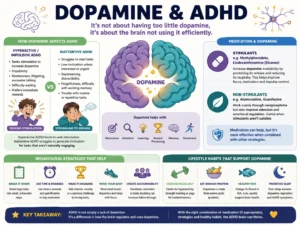


Understanding the way your ADHD brain processes information is the first step towards unlocking its potential. If you have self-awareness you can transform frustration into empowerment, helping you build a life that works with your brain, not against it.
ADHD is about how your brain processes information and manages tasks. This means it’s important that you understand ADHD isn’t about laziness or lack of willpower, so you can learn to work with your brain, not against it. An ADHD brain’s main difference is in the way it manages dopamine, which means it has a harder time signalling that something’s worth the effort right now. So you may find yourself gravitating towards high-excitement activities or having trouble staying focused on tasks that don’t provide immediate rewards. You may also find you only get absorbed in things that really interest you. Your brain thrives on interest not importance
How your ADHD brain works
The ADHD brain struggles with mundane tasks, even if they’re important. This is because ADHD brains are driven by interest, novelty, and urgency. So, if you want to be more motivated, try making tasks more engaging by turning them into games. You can add a sense of healthy competition, or pair them with something you enjoy.
Executive functioning challenges
Executive functioning involves planning, prioritising, and time management. These can seem overwhelming because these skills rely on your brain’s prefrontal cortex, which works a bit differently with ADHD. It’s a bit like having a really enthusiastic, but disorganised, personal assistant. Things that may help you include tools such as planners, visual timers, and step-by-step breakdowns. These can help make your tasks more manageable.
Emotions can be intense
ADHD isn’t just about focus, it’s also about feelings. Emotional regulation can be harder with ADHD. You may find your reactions are stronger, or last longer, than other’s do. Practices like mindfulness, therapy, and journalling can help with processing emotions in a healthy way.
Is hyperfocus helpful or a challenge?
Distractions are common for everyone, but you may find yourself taking deep dives into anything you’re interested in. This is called hyperfocus and can be really useful sometimes. But, as you may already know, can cause problems when it leads to neglecting other important things. Setting alarms or having accountability partners, also called body doubling, can help you manage hyperfocus more effectively. It’s worth noting that hyperfocus isn’t exclusive to ADHD.
You’re not alone
Learning to understand and accept your ADHD brain can be really empowering. Understanding how your brain works means you can start creating systems that work for you, not against you. One important thing to remember. ADHD brains can be just as creative, energetic and full of potential as anyone else’s. With the right strategies and support, you can find ways of reaching your goals and aspirations just like anyone else.
If this resonates with you, try exploring ways to work with your ADHD, rather than against it. Your brain may operate differently, but different can be just as powerful.
Want more help or support? Visit Resources for worksheets, workbooks and links to helpful information specifically for the ADHD brain. Or book a coaching or therapy session.
References:
Executive function theory
Barkley, R. A. (1997). Behavioral inhibition, sustained attention, and executive functions: Constructing a unifying theory of ADHD. Psychological Bulletin, 121(1), 65–94.
Barkley, R. A. (1997). ADHD and the nature of self-control. Guilford Press.
Barkley, R. A. Executive functioning and self-regulation in ADHD [Fact sheet]. russellbarkley.org.
https://www.russellbarkley.org/factsheets/ADHD_EF_and_SR.pdf
Prefrontal cortex development/structure
Shaw, P., Eckstrand, K., Sharp, W., Blumenthal, J., Lerch, J. P., Greenstein, D., Clasen, L., Evans, A., Giedd, J., & Rapoport, J. L. (2007). Attention-deficit/hyperactivity disorder is characterized by a delay in cortical maturation. Proceedings of the National Academy of Sciences, 104(49), 19649–19654.